
01
What a Standing Seam Metal Roof Is
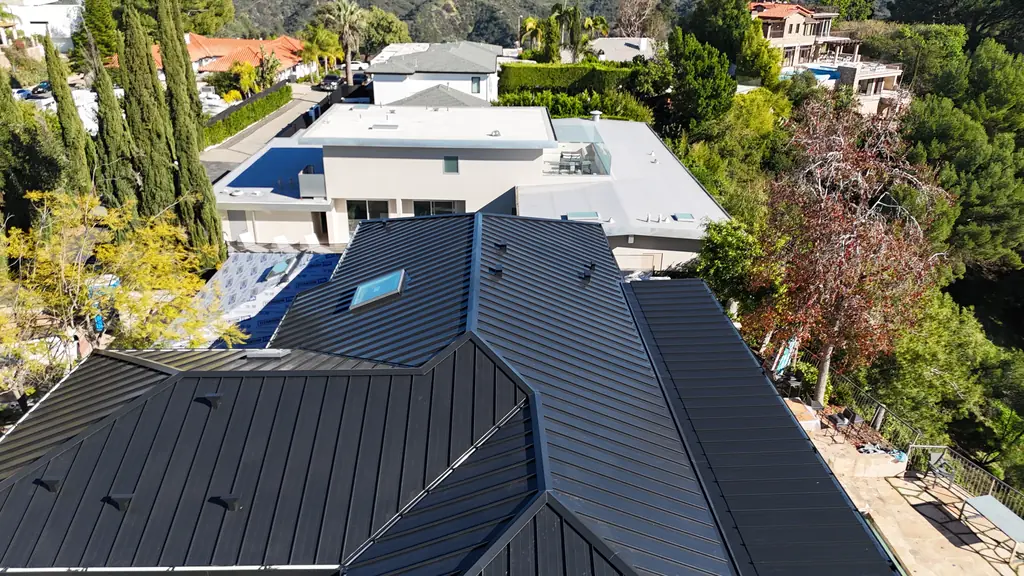
A standing seam metal roof is built from long, flat metal panels laid side by side from the eave up to the ridge. Each panel has raised edges called legs. Where two panels meet, the legs lock together into a seam that stands above the flat part of the panel. Water runs down the flat pans between the seams and never has to cross a joint on its way to the gutter.
The panels are held down by clips that sit under the seams. The clip is fastened to the deck, and the next panel locks over it, so the screws are covered. That is the main difference from exposed-fastener metal roofing, where screws go straight through the face of the panel. With a standing seam metal roof in Pacific Palisades, the field of the roof has no holes in it.
The look is clean and architectural: straight vertical lines, crisp edges and very little visual noise. It suits the modern homes going up across the Palisades and works well on traditional and farmhouse forms too, as long as the details at the edges are drawn with care.
02
Why Panels Are Formed in Our Own Shop
Most of the quality in a standing seam roof is decided before anyone climbs a ladder. Panel width, seam height, the straightness of each panel and the fit of every piece of trim come from the forming equipment and the person running it.
We form our panels and trim in our own shop in Van Nuys. We take the measurements on your roof, then cut panels to the lengths your roof needs and bend the flashings to the angles your details need. The same company measures, forms and installs, so when something on the roof is not quite what the drawings showed, the fix is a phone call to our own shop, not a reorder from a supplier.
It also means trim matches panels. Ridge caps, rake trim, eave trim, valley pans, wall flashings and counterflashings are bent from the same coil as the panels, in the same color and finish.
03
Seam Types: Snap-Lock, Nail Strip and Mechanical Seam
Standing seam is a family of profiles, not one product. The seam type is the first choice we make together, and it follows from the roof slope, the exposure and the look you want.
| Seam type | How it closes | Where it fits |
|---|---|---|
| Nail strip | A fastening flange along one edge is screwed to the deck, then the next panel covers it. | Simple roof planes with moderate pitch and shorter runs. |
| Snap-lock | The legs snap together by hand over concealed clips. | Most residential roofs with enough pitch for the profile. |
| Mechanical seam | The legs are folded closed on the roof with a seaming tool, single or double lock. | Lower slopes, long runs and exposed, windy sites. |
Every panel manufacturer publishes a minimum slope for each profile, and those limits are part of how the roof is permitted and warranted. Snap-lock profiles generally need more pitch than mechanically seamed ones. On the low-slope sections that show up on many modern Palisades homes, a mechanically seamed panel is often the right answer.
Seam Height and Panel Width
Taller seams lift the joint higher above the water and stiffen the panel. Narrower panels show more lines and resist "oil canning," the slight waviness you can sometimes see in wide flat pans under low sun. Both choices change the look of the roof, so we show you samples and photos of finished roofs before you decide.
04
Which Metal: Coated Steel, Aluminum and Others
Most residential standing seam in Southern California is made from one of two metals.
- Coated steel. Steel sheet with a metallic coating, commonly Galvalume, an aluminum and zinc alloy, under a painted finish. It is strong, widely available and a very good value for most inland lots.
- Aluminum. Lighter and softer than steel, and it does not rust. We offer aluminum for homes in salt-air zones, which in the Palisades often means the bluffs and the streets nearest the ocean.
Copper and zinc are also used for standing seam in some architecture. They weather to a natural patina instead of keeping a painted color. If your architect has drawn one of them, we will talk it through, including how it behaves next to other metals on the house.
Where your home sits decides a lot here. Many panel and finish warranties change near salt water, and the distance limits differ between manufacturers. We read the actual warranty for the material we are proposing against your address before we put it in a scope. Our page on coastal metal roofing in Pacific Palisades goes deeper.
05
Finishes and Color
The painted finish is what you see every day and what the sun works on. Premium standing seam finishes are usually PVDF-based coatings (sold under names like Kynar 500 and Hylar 5000), which are known for holding color and resisting chalking over many years. Other paint systems cost less and fade faster.
Color affects more than looks. A lighter, more reflective roof absorbs less heat. Los Angeles has cool roof rules that apply to many residential roofs, and a color's rated reflectance has to meet the number that applies to your roof. We check the rated values for any color you like before it goes on the order, so you do not fall in love with a color that does not qualify.
If you are in a neighborhood with an HOA or recorded CC&Rs, check them for roof color or material rules too. The City does not enforce private covenants, but your neighbors can.
06
What Goes Under the Panels
A standing seam roof is a system, and much of it is out of sight.
- The deck. Solid sheathing in sound condition. On a replacement we check it after the old roof comes off and replace soft or damaged boards.
- Underlayment. A high-temperature underlayment rated for use under metal, because metal roofs get hot in the sun. In fire hazard zones the underlayment can be part of the tested Class A assembly, so it has to match the listing.
- Clips. Fixed and sliding clips hold the panels while letting them grow and shrink with temperature. Metal moves every day between cool mornings and hot afternoons. Panels that cannot move will show it.
- Closures and flashings. Foam or metal closures fill the gaps at eaves and ridges. In fire zones these openings must be closed against embers. Flashings carry water around walls, chimneys, skylights and vents.
07
The Details That Decide How a Roof Performs
Field panels rarely cause leaks. The trouble spots on any metal roof are the places where the roof meets something else. On a standing seam metal roof in Pacific Palisades, these are the details we spend the most time on:
- Valleys. Where two roof planes meet and carry water together. Rustic Canyon and other leafy streets put extra debris in valleys, so the valley pan has to be wide enough and easy to clean.
- Walls and parapets. Modern homes often have roofs that die into walls. Each one needs a step or continuous flashing and a counterflashing set into the wall.
- Penetrations. Vents, flues and skylights. We plan them to land in the flat of a panel, not on a seam, and flash them with boots or shop-made curbs.
- Eaves and rakes. These edges take the wind. The clip spacing near the perimeter and the way the panel locks to the edge trim are what keep the roof on in a strong offshore wind.
08
Wind, Sun and the Palisades Site
Strong offshore winds in Southern California, often called Santa Ana winds, can push hard on roof edges and corners. Ridgeline homes in places like Marquez Knolls and the upper Highlands feel them more. The answer is not a heavier panel but correct attachment: clip type and spacing set to the engineering for your roof, and trims that lock the panel edges down.
Sun is the other constant. A good finish and correct clipping handle it. So does planning for heat at the underlayment, which is why we use underlayments rated for high temperatures under metal.
09
How We Build a Standing Seam Roof, Step by Step
- Site visit. We measure every plane, check pitch, note each wall, valley and penetration, and look at how panels will get from the street to the roof.
- Written scope. The scope names the profile, seam type, metal and thickness, finish and color, underlayment, the fire-rated assembly where required, and who pulls the permit.
- Permit. Work on a home in Pacific Palisades is permitted by the City of Los Angeles Department of Building and Safety (LADBS).
- Fabrication. Panels and trim are formed in our Van Nuys shop to your measurements.
- Installation. Our own crew installs. No subcontractors, ever.
- Inspection and walk-through. The roof is inspected where required, and we walk it with you when it is done.
On a full replacement, the tear-off and deck repair come first. That process is laid out on our metal roof replacement page.
10
Is Standing Seam Right for Your House?
For most Palisades homes with roof pitches the profiles allow, standing seam is a strong choice: it is noncombustible, it has no exposed fasteners in the field, it is light compared with tile, and it holds its looks for a long time when the metal and finish are matched to the site. It is not the cheapest roof you can buy, and we will not pretend it is.
The best way to decide is to have someone walk the roof with you. Call us at (424) 399-5385. You can also see the wider range of our standing seam work on the Eclipse Metal Roofing standing seam page.