
01
The Palisades Is a Coastal Neighborhood, and the Roof Knows It
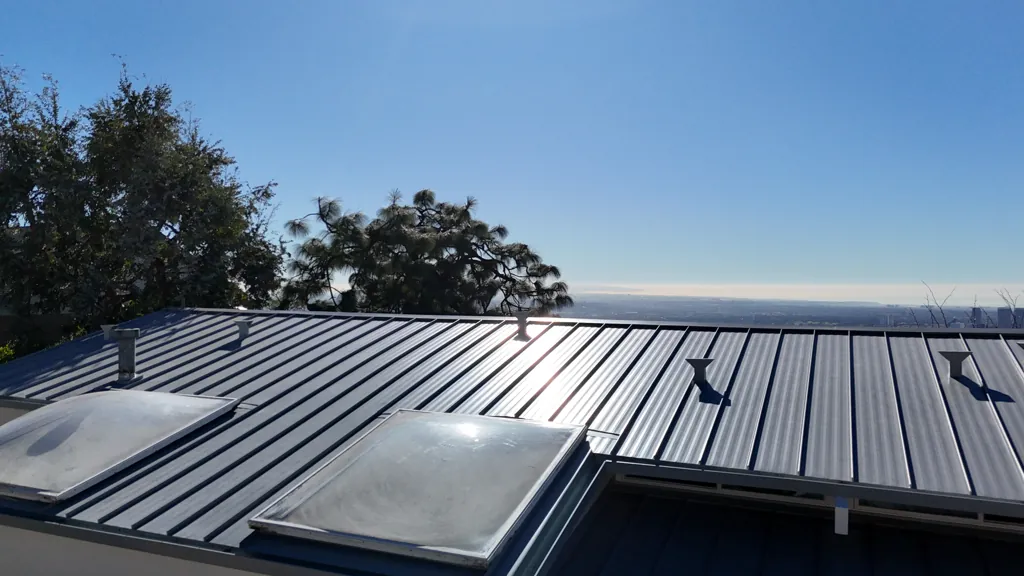
Pacific Palisades runs from the beach and Pacific Coast Highway up the bluffs and into the canyons of the Santa Monica Mountains. Ocean air reaches all of it, but not equally. Homes on the bluffs and in Castellammare look straight out at the water. The Huntington Palisades and El Medio Bluffs sit on the edge above the coast. The Village, the Alphabet Streets and the Riviera are a little farther back. The Highlands and the upper canyons are farther still and higher up.
That spread is why coastal metal roofing in Pacific Palisades is not one recommendation. A roof a few hundred feet from the surf and a roof deep in a canyon face different conditions. We choose materials for the address, not for the zip code.
02
What the Ocean Does to a Roof
Breaking waves throw fine droplets of salt water into the air. The ocean breeze carries them inland, and they settle on roofs, walls, windows and cars as a thin film of salt. Salt pulls moisture out of the air, so that film stays damp longer than bare metal would.
The marine layer adds to it. In late spring and early summer especially, Southern California's coast often starts the day under low cloud and fog, the pattern locals call May Gray and June Gloom. Mornings under the marine layer mean dew on the roof, and dew plus salt is the condition that drives corrosion.
Three things decide how hard this hits your roof:
- Distance from the surf. Salt deposits are heaviest close to breaking waves and fall off as you move inland.
- Exposure. Bluff-top and ridge homes facing the ocean catch more wind-borne salt than homes tucked behind hills or trees.
- Rain-washing. Open roof planes get rinsed by rain. Sheltered areas such as under eaves, behind parapets and below other roofs do not, so salt builds up there.
03
Choosing the Metal
Aluminum
Aluminum does not rust. It forms a thin oxide layer on its surface that protects the metal beneath, and it holds up well in salt air. For homes in salt-air zones, we offer aluminum standing seam. Aluminum is softer than steel, and it expands more with heat, so the panel profile, thickness and clip system have to be chosen with that in mind. It also costs more than coated steel.
Coated Steel
Most residential standing seam is steel with a metallic coating, commonly Galvalume (an aluminum and zinc alloy), under a painted finish. The coating protects the steel, including by sacrificing itself at small scratches. It performs very well in most of Los Angeles. Near salt water, the risk is at cut edges and scratches, where the coating is thinnest and salt can sit.
Many panel and finish manufacturers limit or exclude warranty coverage within a set distance of salt water, and the distance and terms differ by manufacturer. That is the real dividing line for your house. Before we propose coated steel for a coastal Palisades address, we read the warranty for that exact product and check it against your location.
Copper and Zinc
Some architects specify copper or zinc for standing seam. Both develop a natural patina instead of keeping a painted color. If either is on your drawings, we will talk it through, especially where those metals meet others on the house, because copper runoff onto aluminum or coated steel can damage them.
| Question | Aluminum | Coated steel |
|---|---|---|
| Rusts? | No | Coating protects the steel; exposed edges and scratches need care |
| Weight and stiffness | Lighter, softer | Heavier, stiffer |
| Thermal movement | Higher | Lower |
| Near the surf | Our usual choice for salt-air zones | Depends on the warranty terms for your distance |
| Relative cost | Higher | Lower |
04
The Small Parts: Fasteners, Clips and Flashings
On a coastal roof, the trouble rarely starts in the middle of a panel. It starts at the smallest metal parts, and where two different metals touch.
Galvanic corrosion. When two different metals touch and salt water connects them, one of them can corrode faster than it would alone. Aluminum panels need compatible clips and fasteners, and aluminum should not sit in contact with copper or bare steel. We match clips, fasteners and flashings to the panel metal.
Fasteners. Standing seam keeps fasteners out of the roof face, under the seams, which already protects them. The clips and fasteners themselves are specified to suit coastal exposure and the panel metal.
Flashings and trim. Because we bend trim in our own Van Nuys shop from the same coil as the panels, flashings are the same metal and finish as the roof. That avoids accidental mixed-metal joints.
Cut edges. Panels and trim are cut during fabrication and installation. Clean cuts and careful handling matter, and metal filings are swept off the roof as we go, because steel shavings left on a roof rust and stain the finish.
05
Finishes for Sun and Salt
The painted finish is the first barrier against salt and the part that faces the sun every day. Premium finishes for standing seam are usually PVDF-based coatings, sold under names like Kynar 500 and Hylar 5000. They are known for color retention and resistance to chalking. Finish warranties, like panel warranties, can have coastal terms, and we check them for your address.
Color matters for heat too. Lighter, reflective colors stay cooler and help with the Los Angeles cool roof requirements that apply to many re-roofs. We check rated reflectance before ordering any color.
06
Coastal Homes in Fire Zones
A coastal location does not exempt a home from fire rules. Much of Pacific Palisades is mapped as a Very High Fire Hazard Severity Zone, and a re-roof or new roof there generally has to be a Class A assembly. So a coastal metal roof in the Palisades often has to answer both questions at once: the right metal for the salt, and the right tested assembly for fire. Aluminum and coated steel standing seam can both be built as Class A assemblies. The details are on our page about fire-resistant metal roofing.
Homes in the Coastal Zone may also have additional planning steps for new construction or rebuilds. The City's Palisades rebuild FAQ explains how the emergency orders handle Coastal Zone rebuilds.
07
Caring for a Metal Roof Near the Ocean
A standing seam roof needs little care, but a coastal one benefits from a few habits:
- Rinse sheltered areas. Many manufacturers recommend periodic fresh-water rinsing of areas that rain does not wash. A garden hose at low pressure is enough. Never use a pressure washer on a roof.
- Keep valleys and gutters clear. Leaves hold moisture and salt against the metal. In fire zones, clear debris is also an ember precaution.
- Look after scratches. If something scrapes the finish, such as a fallen branch or a solar installer's tool, let us know. Small scratches on coated steel are best touched up as the manufacturer directs.
- Watch other trades. Satellite dishes, solar racking and HVAC work can add mismatched metals and screws to a roof. Ask them to use compatible materials, or call us first.
08
Why We Are a Good Fit for Coastal Metal Roofing in Pacific Palisades
Choosing coastal materials well means slowing down at the start: the address, the exposure, the warranty terms, the metal, the clips and the trim. We control all of that because we form our own panels and trim in Van Nuys and install them with our own crew. No subcontractors, ever. We have been roofing in Los Angeles since 2006 under California contractor license #888710.
To talk about a roof near the water, call us at (424) 399-5385. More about our standing seam systems is on EclipseMetalRoofing.com.